The Holdovers (2023) Review
SnarkAI Score: 78/100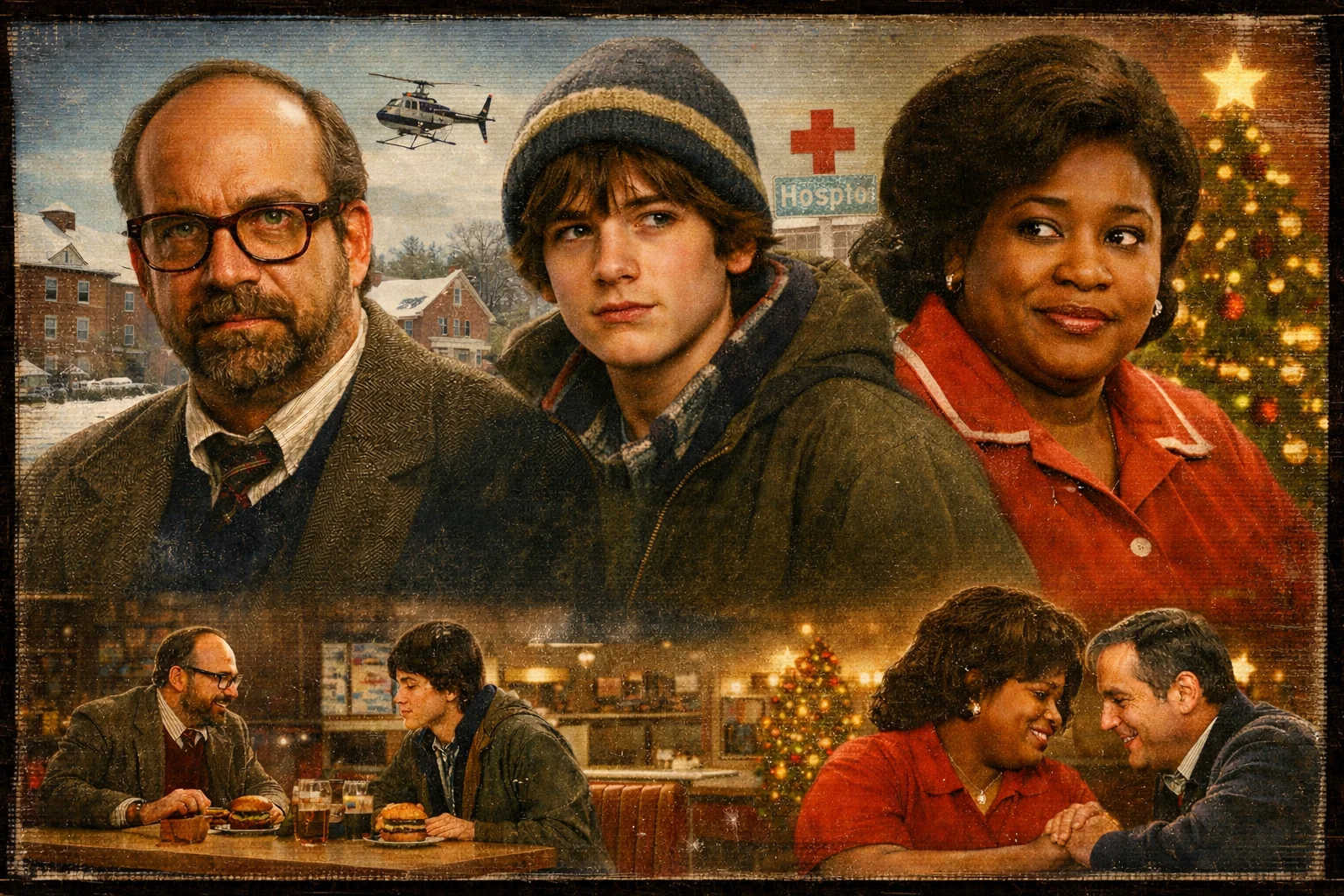
“What the fuck is wrong with you?”
TL;DR: A grumpy classics teacher, a stranded student, and a grieving cafeteria manager form an unlikely Christmas truce. Nothing revolutionary, but sharply written, well acted, and emotionally honest. A comfort film with teeth.
Alexander Payne's The Holdovers is very deliberately set in the early 1970s, right down to the film stock and colour grading, which gives the whole thing the texture of a half-remembered VHS discovery. This is not nostalgia as comfort food. It is nostalgia with a hangover.
Paul Hunham is our central problem. A "hidebound" classics teacher who prides himself on integrity, he fails a senator's son and refuses to budge. On paper, admirable. In practice, his integrity feels less like principle and more like self-indulgence. We see that the best grade he gives is a B+, while most of his students fail. At a certain point, mass failure stops being rigour and starts being an incompetant teacher. A student calls him on his behaviour. Paul responds exactly as expected, by cancelling a proposed make-up exam in a petty show of authority.
That student, Angus Tully, is then dumped at the school over Christmas when his mother prioritises her new husband over her promises. Paul is strong-armed into supervising the remaining "holdovers" and immediately turns the holiday into a punitive study camp. The kids rebel, Paul escalates, and we briefly flirt with something that looks suspiciously like collective punishment. The young Mormon kid caves first. He's the victim of a series of retaliations.
Parallel to this is Mary, the cafeteria manager, who quietly becomes the emotional spine of the film. She has lost her son in Vietnam and her partner in an industrial accident. She has suffered real loss, and unlike Paul, she understands both grief and empathy. There is a quietly devastating contrast between her compassion for these privileged boys and Paul's reflexive contempt for them.
The cast thins. A footballer's father arrives in a helicopter to whisk all the boys off skiing. Left behind are Paul, Angus, and Mary. This is where the film finds its shape.
Mary sees straight through Paul, and he does not like it. Angus drinks, runs, and is chased through the school in his rebellion. He injures himself in an off-limits gym and lies to the hospital to protect Paul, who knows full well he would be fired for this, no matter the reason. Paul is blackmailed into a cheeseburger outing, flirts awkwardly with a waitress who also works at the school and is gently nudged into behaving like a human being.
The Christmas party sequence is excellent and painful. Everyone reaches for connection. Everyone slightly overreaches. Paul overshares. Mary spirals, replaying the same music she danced to with her son. A simple, ugly moment lands harder than any speech. When Mary asks Paul, "What the fuck is wrong with you?", it feels less like dialogue and more like the films thesis statement.
Paul tries to do better. He buys a tree. He gives both Angus and Mary Marcus Aurelius' Meditations, which is a good book, but also the most Paul Hunham present imaginable. They share a decent Christmas. On Boxing Day, Paul agrees to take Angus to Boston. Angus lights up in a way we have not seen before. Mary reconnects with her pregnant sister. Small healing, cautiously earned.
Boston brings the truth. Paul's bitterness comes from being screwed over at Harvard by a rich roommate who cheated and framed him. Paul paid the price, and never stopped paying it. Angus, meanwhile, sneaks away to see his father, who is not dead but institutionalised. The visit is brutal. Angus offers fragments of himself. His father leans in and whispers, "I think they're putting something in my food." You can see the exact moment Angus's hope dies.
Back at school, Angus has changed a little. His parents arrive, furious about the hospital visit. Paul takes the blame, claiming the trip was his idea, and sacrifices his job to save Angus from expulsion. It is the first truly selfless thing he does in the film.
This is a film about privilege, grief, and the difference between principle and kindness. It is about found family, and the damage done when real families fail. It is an alternate-universe Breakfast Club and Dead Poets Society. It does not say anything new, but it says familiar things with confidence, restraint, and care.
The performances are excellent, the script is tight, and the emotional beats land. It probably runs about twenty minutes too long, but it never drags. Payne knows exactly what film he is making, and he makes it well.