KPop DemonHunters (2025) Review
SnarkAI Score: 68/100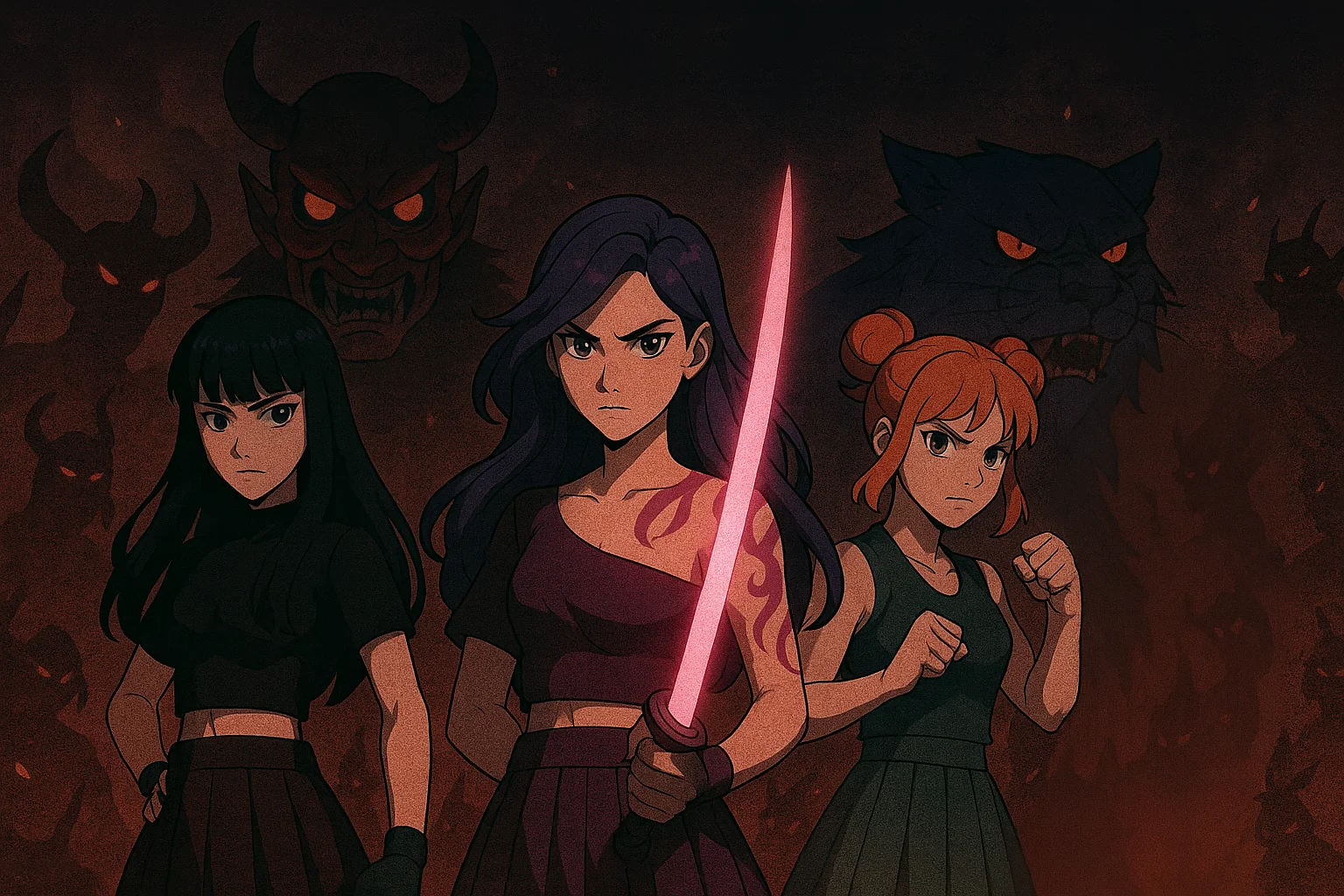
“Hunters or Demons, the real monsters are record executives.”
TL;DR: A fun but flawed anime-musical hybrid that takes K-pop, demon hunting, and girl power and throws them in a blender. The 3D animation looks odd with 2D anime shortcuts, but the demon designs are great and the songs are genuinely catchy. Flirts with queer themes through gender-nonconforming demon boy bands and Rumi's shame about her markings, but never fully commits to the allegory. The middle drags with too much dithering over diss-track lyrics, and the finale still needs a man's sacrifice to save the day. It's woke but could have been awake.
So popular it pushed the big-budget Superman from the box office top spot, and so talked about I nearly didn't watch it because I'm contrary about things everyone loves. I can't say I'm a fan of K-pop, but I'm a huge fan of anime, demons, and demon hunting.
The premise is simple. Demons steal souls, strengthening the Demon King. Humans called Demon Hunters emerged, singers who fight with song. Every generation has three women whose harmonized voices maintain the Honmoon, a protective blanket against Hell. They also do martial arts while fighting. Imagine you took Charmed, Buffy, and Pitch Perfect and threw them in a blender. That's the general concept.
The animation isn't great. It suffers the same issue as Earwig & the Witch. The visuals are 3D, but they're still using 2D anime shortcuts like exaggerated tears and puffed cheeks. It looks extremely odd in the context of the more realistic 3D. The demons, however, look great, resembling traditional Asian demon masks.
The girls are kidnapped in their private jet by demons who are unconvincing as humans. When they realize it, they quickly defeat them through fighting and singing, then leap from the plane without parachutes to land mid-stadium for their (very late) concert. It's fun, but is no one worried about the unattended commercial jet now spiraling through the sky?
Hell looks great, with an almost claymation vibe. The Demon King is angry and throwing a tantrum until a lute-playing demon called Jinu turns up with his Blue Tiger, singing a song mocking the King. He's joined by four identically dressed friends who suddenly pose, making it obvious before the King says it: "A Demon Boy Band." The lead singer of the demon boy band wants some memories erased as payment for executing his plan to fight the girl band who protects the world with his evil boy band. You'd think after 400 years he'd be used to them.
The girls are looking forward to downtime, but their leader instead launches their new single. Everyone loves it. (It's a great song, "Golden." It's everywhere.) One minor thing that annoyed me: during the song, they show someone watching on their phone, and the scrubber is in the first third, but the song is almost over.
The purple-haired girl, Rumi, has demon marks affecting her voice. She runs off into the night, thinking of her mother saying she won't be fixed until the marks are gone and the world is safe. She yells, and a magenta wave laps over the blue protective waves.
The doctor they visit, rather than examining her, complains she's closed off and doesn't go to the bathhouse with her friends. We're perhaps supposed to think he's a wise healer, but he comes across as a charlatan, particularly since the "tonic" he gives them has his own face on the package.
They meet the evil boy band, the Saja Boys, and are instantly smitten with the twinkiest twinks who ever twunked. I'm not sure if it's a deliberate play into conservative hysteria about homosexuality and demons, but George Michael, Elton John, and Freddie Mercury would bring a more traditionally masculine energy to their songs than these demons. The name of their fandom is "The Pride." That can't be an accident.
The Saja Boys set the girls up to fight an army of water demons. (I'm not sure why some demons can reach Earth and others can't.) Jinu sees the markings on the girls' leader and realizes she's part demon, so he covers them to protect her secret.
There's a great moment when Bobby the exec looks up from his phone, leans against the penthouse window, and says, "It's just social media numbers, not the end of the world." The three girls see in the glass's reflection the magenta holes in the protective blanket. Bobby can't see it, but he's looking out at the end of the world.
The Blue Tiger finds Rumi, accompanied by its friend the six-eyed pilgrim magpie, which the creative team call Derpy and Sussie respectively, and drops off a letter from Jinu. The cat sinks into the ground in a lovely effect. Its fixed grin makes it look like a startlingly dumb dog. She rushes the bad guy and decapitates him. He'd set up a mannequin and seems disappointed she killed it. They spar, physically and verbally.
We learn demons are just people who took the Demon King's deal. Once the patterns consume you, you go to Hell. The Demon King's voice reaches out to those with marks and those who might accept them, except for the girls' leader.
The girls go hard killing demons and writing a diss track. Rumi's friends are oblivious to her growing uncertainty. The Cheshire Cat hangs out in her room a lot and steals her work-in-progress lyrics.
The middle drags. Too much "will they, won't they," too much dithering over diss-track lyrics, and too little demon-slaying. We find out Jinu didn't give up his soul to save his family. He abandoned them for a life of wealth and privilege. That's the memory he wants erased, his selfishness.
The girls perform "Golden" instead of the diss track. Then "Takedown" starts, and Rumi is stripped of her costume, revealing her patterns. Demons pretending to be her bandmates expose her. The audience has no idea what's happening, but the real Hunters arrive just in time to see her marks. They're betrayed by her secret alliance with Jinu. Rumi tries to convince them to stay, but her anger and desperation cause a magenta wave as they raise their weapons.
Rumi learns the truth about Jinu. The Saja Boys win the awards. The Demon King's voice reaches everyone. The others head to the Saja Boys concert, while Rumi confronts her mother in an emotional scene. She teleports away, saying the Honmoon should be destroyed.
Rumi confronts the Demon King. She has accepted who she is and can create a new Honmoon. Her patterns glow as she walks forward singing. Her friends back her up. It's a good joke, but Buffy did it better. Rumi stands against the Demon King's power and is saved by Jinu's sacrifice. It's disappointing that the intrinsically female power of the Hunters still needs a man's strength to win. The souls of the audience support Rumi and the Demon Hunters as they defeat the demons, the remaining Saja Boys, and restore the Honmoon. The song needed a stronger bridge than "this is what it sounds like." It's not as soaring as "Golden," which is a shame.
Her scars remain but fade to pale silver. She enjoys seeing her fans and finally goes to the baths with her friends. Watching them are Derpy and Sussie, who somehow stayed in the human world.
Between the gender-nonconforming Saja Boys and Rumi's shame about her markings, the film flirts with queer themes but never commits. "I'm done hidin', now I'm shinin' like I'm born to be" is hard to read as anything but a coming-out allegory. When Rumi faces her mother, she says, "You told me to cover up. To hide." Her mother answers, "Yes, until we could fix you." Plaintively, Rumi cries, "Why couldn't you love me, all of me?"
KPop DemonHunters isn't a great film, and it sidesteps too many ideas to be truly challenging, but the songs are fun, the story is well-paced, and the characters are likable. It could have been more with a little more bravery. It's woke but could have been awake.