The Man Who Killed Hitler and Then the Bigfoot (2018) Review
SnarkAI Score: 45/100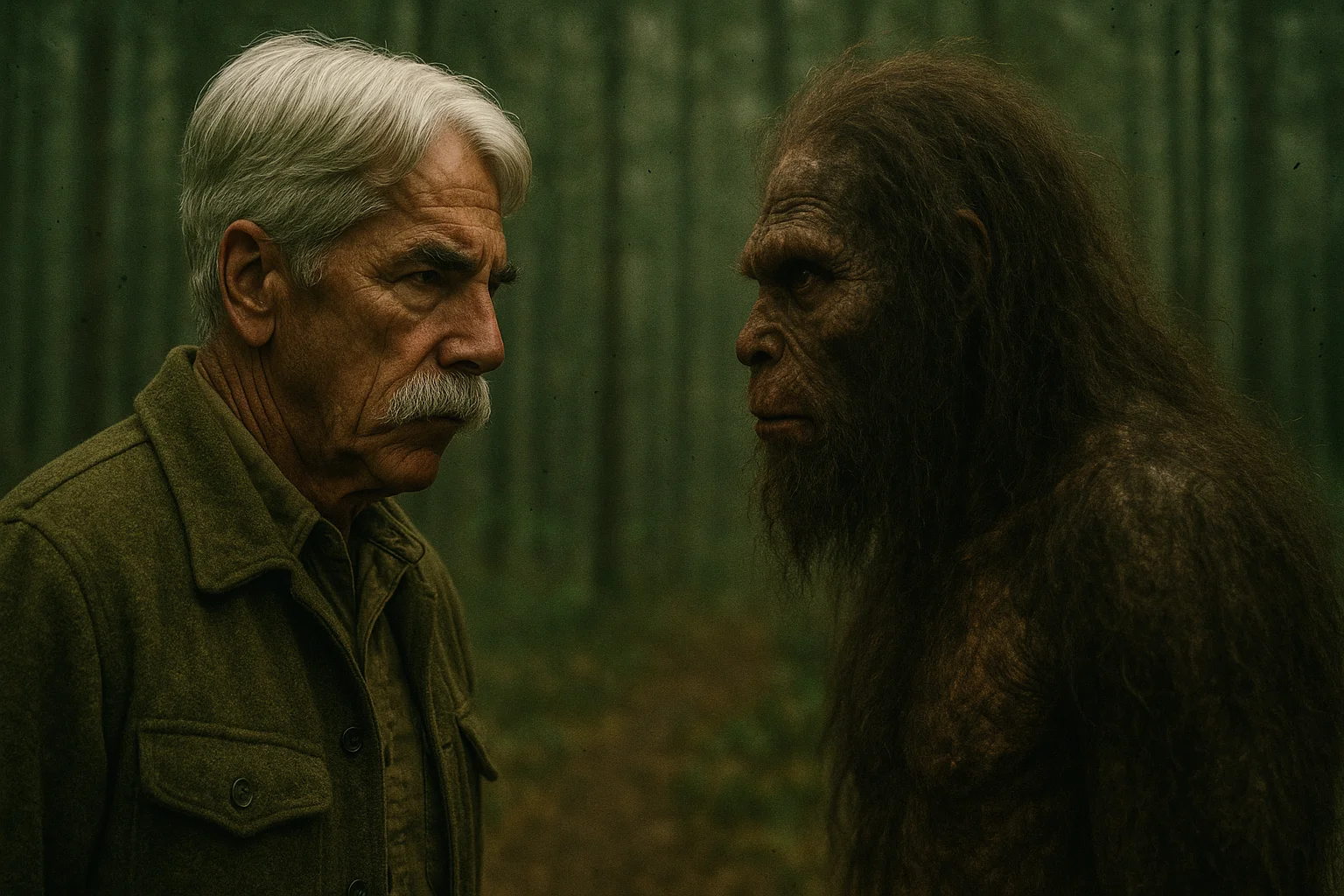
“It's not a good film and it's not bad enough to be fun.”
TL;DR: Sam Elliott stars in a bizarre mashup that should've been two separate films. The Hitler assassination backstory could be compelling if taken seriously, and a retired hunter vs Bigfoot could work (see Prey), but mashing them together with a nonsensical plague subplot creates tonal whiplash. Elliott's immune to a deadly virus for no reason, the government ignores basic science, and Bigfoot looks like a budget mummy. The attempted cremation scene is accidentally hilarious. It takes itself way too seriously for such a daft premise, but it's not quite 'so bad it's good' either - just mediocre.
It has Sam Elliott and a bunch of "oh, I know that guy" actors in it. It's genuinely a surprisingly strong cast for such a clearly "straight to VHS" style film.
The plot is exactly what it sounds like. And makes just as much sense. There's a super plague that's not in the title but I guess "The Man Who Killed Hitler and Then the Bigfoot and Stopped a Plague" is a bit wordy even for director Robert D. Krzykowski's debut film. His two later films are much punchier titled: "The Woman" and "Grendel."
Sam's character was the man who actually killed Hitler. At approximately 42 years old, this American Special Forces soldier made it through the Nazi lines, despite looking like a drawing of a cowboy so yee-haw no one would think him German. The Nazis replaced Hitler with a body double and just carried on. Sam feels his life was pointless as the assassination was kept confidential. Which makes sense if the result was people thought he killed himself due to not having faith in the Nazi war anymore, but as they replaced him, revealing Adolf Hitler was a fake would surely have damaged Nazi morale.
Sam's immune to the deadly plague for some reason - likely his magnificent mustache acts as an effective air filter. It has nothing to do with his assassination of Hitler, no suggestion he was given some experimental drugs to help him cross no-man's-land. No German experiment on him. Nothing. This is a very odd part of the story, as to the world at large it never happened, and nothing in the story translates to Sam's immunity to the Bigfoot virus, so we wonder why it even matters other than as a colourful and fun anecdote he can only tell his dog.
Despite this immunity to the Bigfoot virus that will kill all living things (other than Sam and a few others), the government decides he's best to send to fight the Bigfoot hand to hand rather than, you know, do some tests on him to find a cure or vaccine. (This movie predates the prevalence of anti-vaxxers so even that is not an excuse!) The government's theory is if they kill Bigfoot he will stop spreading the virus. Which means it's not airborne and not contagious between hosts. So somehow everyone who has died must have met Bigfoot in person, somehow, exchanging fluids and then dying. As if it was a disease contractible host to host, killing Bigfoot would do nothing. Unless it is a magic virus I guess that depends on Bigfoot being healthy.
He naturally finds the Bigfoot, which is very silly-looking both as a deliberate choice and due to budget. It is more like a mummy or a ghoul than an animal. They fight three times. First time Bigfoot is injured and Sam thinks it is dead. Second time Sam is maimed. Playing "Best of Three," Sam kills Bigfoot.
The attempted cremation scene of Bigfoot after the first battle is unintentionally hilarious. There's projectile vomiting. It's not great.
Sam seems to die of his wounds in the forest, and Sam gets his own funeral, less hilarious than Bigfoot's. He's secretly alive and meets his brother - who showed up in the initial scene setting - and his dog to go fishing. Sam's feeling fulfilled now he secretly saved the world by killing Bigfoot after secretly not quite saving the world killing Hitler didn't do much for his mental state.
Sam then digs up his own casket and takes a box that was buried with him for some reason. We never find out what is in the mystery box.
This is one of those films that takes itself way too seriously for the incredibly daft concept and execution. It suffers from the American adoration of the lone hunter/hero and the nobility of hunting as an activity, and these tropes force the plot in poor directions.
However, this could have been two separate decent films. A retrospective of a man who killed Hitler, went through hardship and hell to do it, with no recognition and with no seeming result would be interesting. Sam Elliott could probably manage it, but I think a stronger choice would be a German actor. Then a film about a retired hunter stalking Bigfoot (skip the plague, it's nonsense) can also be compelling. Though Predator's Prey got fairly close to this idea.
Overall, it's not worth the time to watch, but if you're having a film party and the theme is "so bad it's good," it's not a terrible choice.